
Following my latest article on real estate, and given my natural aversion to the industry, writing about a homebuilder may seem strange. However, I believe that remaining open-minded about every potential opportunity is the right way to study businesses.
Smith Douglas Homes operates differently. Traditional homebuilders are capital-intensive, long-duration business. A builder may purchase raw land, wait for planning approvals, invest in roads and infrastructure, construct houses and over a long period, hope that demand and prices remain strong for those houses.
During that period, a lot can change, and a large amount of capital remains tied up, often supported by debt.
Instead of owning and developing most of its land, Smith Douglas primarily controls its future lot pipeline through option agreements with third-party developers. This creates a much more capital-light business, where most of its future land do not appear on their balance sheet, and they have the flexibility to just decide not to go forward or reduce investments quite rapidly. They still have to commit some capital through option deposits.
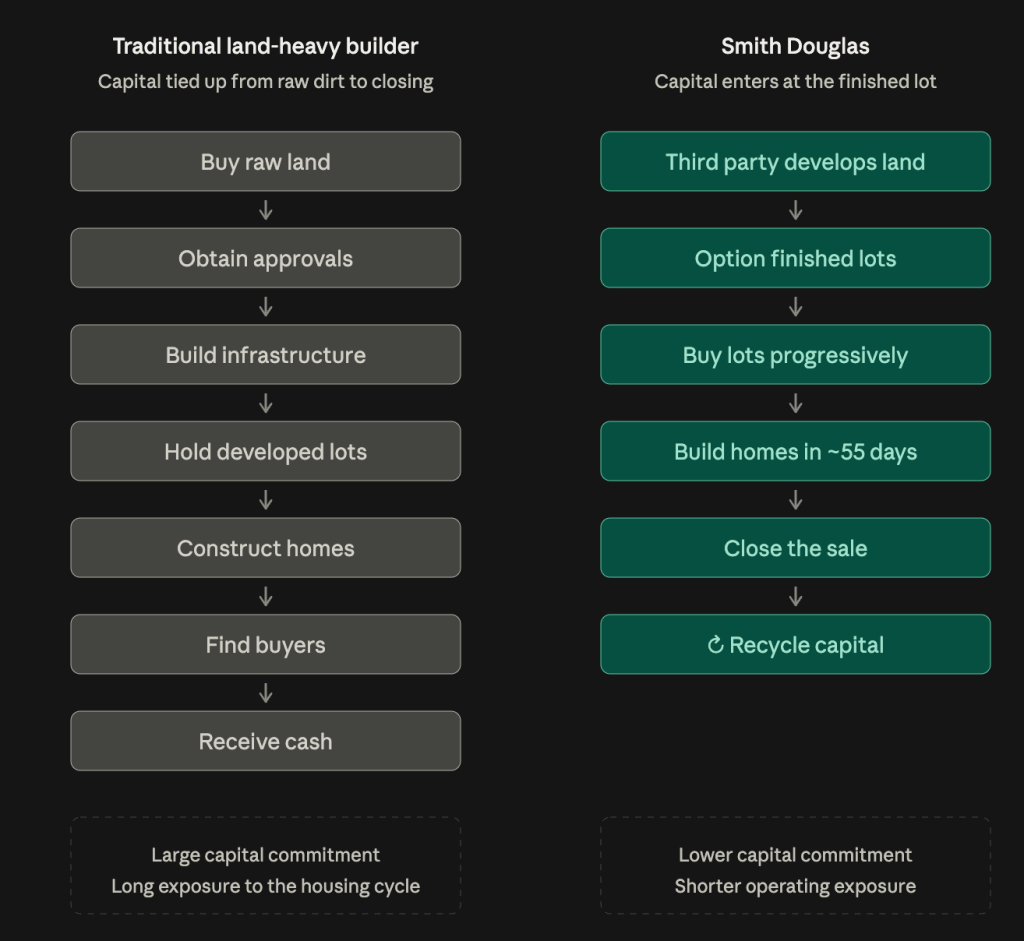
The company also uses a standardized house plan, and a very efficient operation model where they can complete homes in approximately 55 to 60 business days. That for me looks quite astonishing. I’m used to the construction of houses to take place someone between one to two years.
This combination allows them to not only operate with minimal debt, but don’t suffer from having capital tight up with risk of duration, interest rates, and downturns in the economy. It does not completely insulate them, but it gives them more flexibility when conditions deteriorate.
Smith Douglas looks to be structurally better business model than most of homebuilding businesses.
To be fair, the company is not the first to use this model. NVR is probably the best example, one of the business companies in the industry and with outstanding shareholding results over the years.
Founded When Nobody Wanted to Build
Smith Douglas was founded at a moment when starting a homebuilder appeared irrational. The US housing market was collapsing, established builders were retreating, and financing and buyer confidence were under severe pressure. Starting the company in 2008 made me interesting in how management operates, as I found it quite unusual.
Yet Thomas Bradbury, the founder of the company, was not entering the industry for the first time. He is a veteran in the industry. He first founded Colony Homes in 1975, where he built the company to a huge success, becoming one of the largest privately owned homebuilders in the Southeast, generating sales of $244 million across nearly 1,900 single-family and townhome units in 2003.
He decided to sell the company in 2003. Five years later, the KB Home, the new owner of colony homes withdrew from Atlanta.
Starting a new company in 2008 was a bold decision that tells me much about the character of Tom Bradbury. He’s a contrarian by nature, and a skew capital allocator, as long as a very good operational. There is a good video about him and the company that I highly recommend https://www.youtube.com/watch?v=tr2O7rBf2GE
Although Bradbury is no longer CEO, the company is led by Greg Bennett, who previously worked alongside him at Colony Homes.
IPO and structure
Smith Douglas completed its IPO in 2024, raising capital to support its expansion into existing and new markets.
At first, I found its ownership structure confusing. Smith Douglas uses an Up-C structure, which creates different classes of shares and leaves much of the original ownership inside the operating LLC. Once you separate economic ownership from voting control, however, it became easier to understand.
The listed company sits above Smith Douglas Holdings LLC, where the actual operating business is held. Public investors own Class A shares in the listed company, while founder Tom Bradbury and CEO Greg Bennett retained most of their economic interests directly through units in the operating LLC.
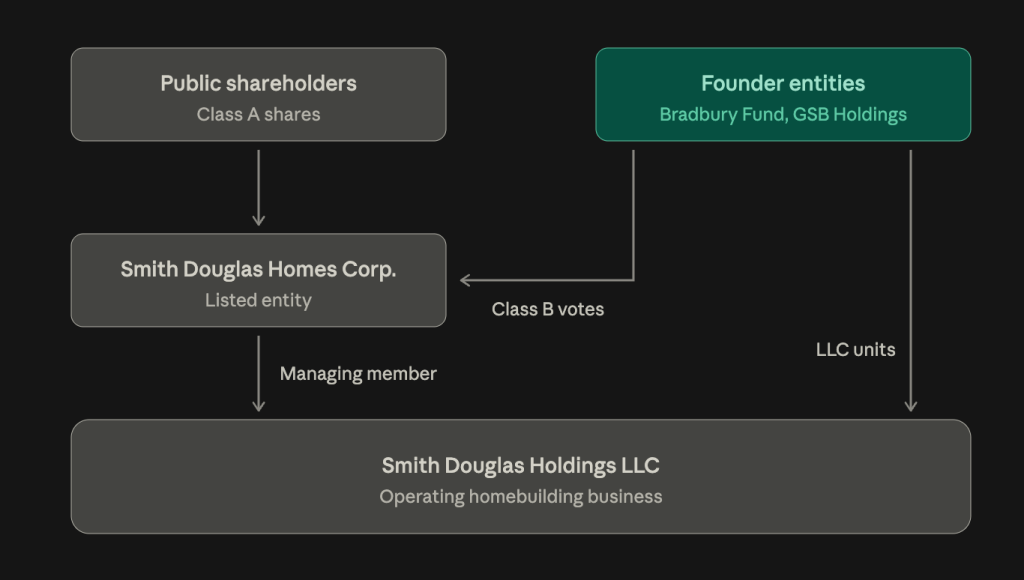
On a fully converted economic basis, the structure looks as following:
- Bradbury Founder Fund: 75.2%
- Greg Bennett’s GSB Holdings: 8.4%
- Public Class A holders: 16.4%
Together, the Bradbury Founder Fund and GSB Holdings own approximately 83.6% of the economic interests. Their voting control is even greater. Through the Class B shares, they control approximately 98% of the voting power, with the Bradbury Founder Fund alone controlling about 88%.
This creates unusually strong economic alignment. Bradbury and Bennett have far more capital invested in Smith Douglas than public shareholders collectively, so they benefit directly if the value of the underlying business increases.
The structure reminds me of Interactive Brokers, another company I admire. Both companies allow public investors to participate alongside highly invested founders, but neither gives outside shareholders meaningful control.
The structure also complicates the accounts. Because much of the operating company is still owned through private LLC units, a large portion of consolidated income and equity appears under non-controlling interests. Investors must therefore value Smith Douglas using approximately 50.8 million fully converted economic units, not only the roughly eight million Class A shares trading publicly.
SMART Builder: The Software Behind the Production System
A construction time of approximately three calendar months does not happen simply because workers build faster. It requires dozens of subcontractors and construction activities to occur in the correct order, with materials, inspections, and labor available when needed.
Smith Douglas supports this process with SMART Builder, its proprietary integrated enterprise resource planning system. The software works alongside the company’s Rteam production model to support its schedule-driven approach to homebuilding. Smith Douglas also operates a trade portal through which employees and external trade partners can access the system.
This software and system are part of the solution that allows them to build so fast and allows for a scalable model to maintain growth while being able to maintain the fast-building pace.
Why Speed Matters Financially
Construction speed is not merely a marketing benefit. It affects the amount of capital required to operate. A house under construction is inventory.
A shorter construction cycle allows the company to:
- Hold less work-in-progress inventory for a given level of closings
- Reduce its exposure to changes in material and labor costs
- React more quickly when local demand changes
Smith Douglas does not need exceptionally high margins or large financial leverage if it can turn its capital rapidly.
The financial mechanism is somewhat like efficient retailers such as Walmart or Costco. These are obviously very different businesses, but they demonstrate how modest margins can still produce attractive returns when capital turns quickly.
To have good returns, you either have a high margins business, and it allow you to have a lower turnover, or you have lower margins but with a faster turnover of that capital.
It’s the velocity on their business model that allows the company to generate attractive returns on capital employed compared with other homebuilders.
That is why this machine is so important, and why they are willing to sacrifice lower margins in the short term to maintain the machine working.
Return on Equity
The company has been going a downturn in their business since 2024. Another think that makes me think they are a very good capital allocator; they choose to go to the market in a right moment.
Since 2024 those margins have been going down and even thought I don’t know if we are at the bottom or not, I will reference 2025 as a more normalized level for the company.
In 2025 company generated a consolidated net income of approximately 68.4 million dollars.
Total equity was approximately 422.9 between 2024 and 2025
2025 consolidated ROE= 68.4 / 422.9=16.2%
That is an attractive return for a business carrying relatively modest financial leverage.
Now, 2026 is going to be a substantially worse year. While they continue to ramp up construction and making the machine work great, margins have been creeping down, and the company barely did profit last quarter.
The main question is
Is Smith Douglas temporarily sacrificing margin to preserve production volume, or has competition permanently reduced the return available from its fast-cycle model?
I believe the margin pressure is temporary rather than structural because orders, closings, and community count continue to grow, while the company has preserved its short construction cycle and land-light model.
However, another several quarters of heavy incentives and negligible profitability would weaken that conclusion.
Valuation
As of the morning of September 3, 2026, Smith Douglas traded at approximately $11.25 per Class A share, implying an economic market capitalization of approximately $572 million. The stock’s 52-week range was $10.72 to $23.49.
It is important not to multiply the share price only by the approximately eight million publicly traded Class A shares. Smith Douglas has an Up-C structure with a much larger number of exchangeable operating-company units held by the founder and CEO.
A current market-data source reports approximately 50.83 million fully converted shares or economic units, which reconciles to the approximately $572 million market capitalization at the current price.
The difficulty is that Smith Douglas only looks cheap if my estimate of normalized earnings is approximately right.
| Scenario | Normalized earnings | Implied P/E at $572M |
| Depressed | $40M | 14.3× |
| Conservative | $55M | 10.4× |
| Base | $65M | 8.8× |
| Stronger recovery | $75M | 7.6× |
| Return toward prior conditions | $90M | 6.4× |
These are my scenarios, not company guidance.
The pessimistic case assumes that affordability, competitive incentives, and finished-lot costs keep earnings well below 2025 levels. The base case assumes Smith Douglas eventually earns approximately $65 million, slightly below 2025’s $68.4 million despite a larger community and revenue base. The stronger cases require meaningful margin recovery.
The sensitivity is substantial. On Q2 revenue of $273 million, every 1 percentage point of gross margin is worth approximately $2.7 millions of quarterly gross profit before taxes and other costs.
At a 17.6% gross margin:
273 * 17.6% = 48 million
At a 22% gross margin:
273 * 22% = 60 million
A recovery from 17.6% to 22% would therefore add approximately $12 million of quarterly gross profit at the same revenue level. This is my calculation using Smith Douglas’s reported Q2 revenue and margin.
Unfortunately, the same sensitivity works against shareholders when margins fall. A few percentage points can separate a very profitable quarter from one in which Smith Douglas earns almost nothing.
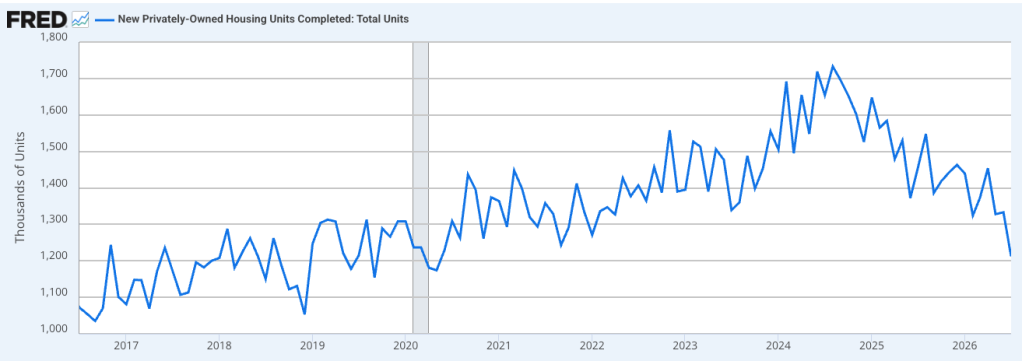
Completions levels have been falling sharply since 2024, the time of the IPO, and are now below the average of the last decade. However, these levels are below what most studies indicate for what should be the minimum levels to match current household formation (around 1.4 million). And there is also a shortage of supply accumulated from low levels of building since the financial crisis. Freddie Mac estimates that the United States was short approximately 3.7 million housing units as of Q3 2024.
Need is not the same as purchasing power
This makes it a good structural position to be in for the industry. However, affordability is affecting the short-term sales. Mortgage rates are at 7%, and the costs of buying a house have been pushed higher.
There is substantial new-home inventory relative to current sales. In July 2026, the Census Bureau estimated:
· 607,000 new single-family home sales at a seasonally adjusted annual rate;
· 488,000 new houses available for sale;
· 9.6 months of new-home supply;
· a median new-home sale price of $393,800.
this means there is a lot of inventory relative to current purchasing demain, even if the country remains short millions of homes relative to long-term demographic.
In sum, there is short pain at the moment, but long-term trends look healthy. For investors with a long time frame this is a good position to be in.
What Must Happen for the Thesis to Work
I do not need mortgage rates to fall next year for the thesis to work, although that would be a nice tailwind. I do need to see evidence that Smith Douglas can eventually restore acceptable margins without abandoning the operating model that attracted me in the first place.
I would monitor five conditions.
1. Margins must recover
They do not need to return to 2024’s 26.2%, but profitability near Q2 2026 levels cannot support the valuation thesis.
2. Community growth must create economic value
Opening more communities is useful only if orders, gross profit, and cash generation eventually grow faster than the equity and working capital committed.
3. The construction cycle must remain short
The 55-day cycle is central to the capital-efficiency argument. A material deterioration would weaken the thesis.
4. Land ownership and leverage must remain controlled
If Smith Douglas begins owning materially more land or using significantly more debt, it will become increasingly similar to the conventional builders it currently appears to improve upon.
5. Cash must eventually follow earnings
Growth can consume cash temporarily through inventory and lot deposits. Over a complete cycle, however, the business must convert its accounting returns into cash available for reinvestment or repurchases.
What Would Make Me Wrong
I would reconsider the thesis if:
· Margins remain structurally depressed, even after affordability and competitive conditions improve.
· Community growth fails to produce adequate returns, with inventory, debt, and overhead growing faster than normalized earnings.
· The land-light model begins to weaken, through materially greater land ownership, recurring abandonment charges, or increasing leverage.
· The production advantage deteriorates, either through longer construction cycles or evidence that speed is compromising quality.
Conclusion
Smith Douglas is still a cyclical homebuilder. It sells a product whose affordability depends heavily on mortgage rates, consumer confidence, employment, and local competition.
But it does not appear to operate like a conventional land-heavy developer.
By controlling most lots through options, coordinating construction through a repeatable production system, and completing homes in approximately three calendar months, Smith Douglas reduces both the amount and duration of capital committed to each house. That model produced approximately 16.2% consolidated ROE in 2025 without depending on high financial leverage.
The latest results reveal the weakness of the model as clearly as its strength. Smith Douglas is successfully growing communities, orders, closings, and revenue, but current margins are so compressed that this growth is producing very little profit.
At approximately $572 million of economic market value, the shares appear attractive if Smith Douglas can normalize around $65 million to $75 million of annual earnings. Under those assumptions, the stock trades at approximately 7.6 to 8.8 times normalized earnings. If sustainable earnings are closer to $40 million, the valuation is much less compelling.
This is a company that I am currently not invested but will follow closely.
My thesis is therefore not that the housing cycle has reached its bottom.
It is that Smith Douglas has built a homebuilding system capable of generating mid-teen returns on equity across a cycle, and that the current price reflects doubt about whether those returns will reappear.
That doubt may be the opportunity.
It may also be the warning.
Disclosure: This article reflects my personal analysis and is not financial advice. I may own, purchase, or sell securities discussed in this article. The valuation scenarios are my estimates and may prove incorrect.
 Diogo Gonçalves
Leave a comment