For most of my investing life, I’ve been very averse to investing in real estate. My aversion has cost me good opportunities in the last decade, and I may have been too conservative.
That may sound strange given my background. My family owns a construction company, and i grew up with exposure to the industry. I also lived through, when I was young, a very real boom and bust cycle in Portugal.
That experience, as a teenager, did not make me more comfortable with properties. It made me more aware of their risks.
I saw the construction business was cyclical, capital-intensive and highly sensitive to financing conditions.
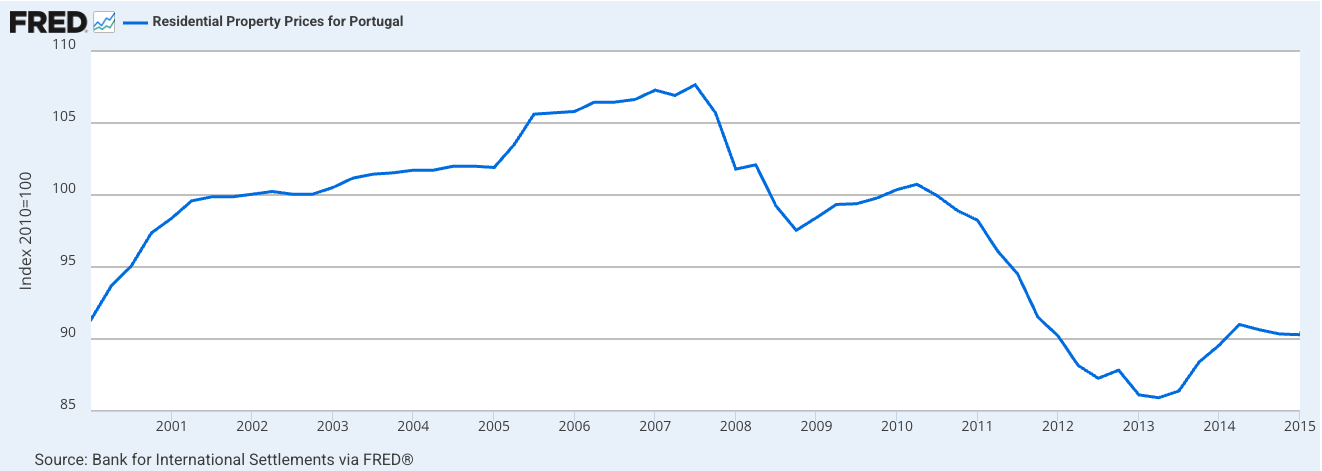
If we look at House Prices from 2000 to 2015, prices remained flat for 15 years, and they had a decrease of more than 20% from the peak.
Looking at sentiment today, it’s clear the collective memory of the crisis is gone. I hear so many people I take in high regard, saying things like prices will always go up for properties. That may be true in the long term, especially because of inflation, but that long term can be much more than they expected.
House prices in Japan are still lower than in 1992 when I was born. (see here)
The reality is the last 10 years have been amazing for those who have houses in Portugal.
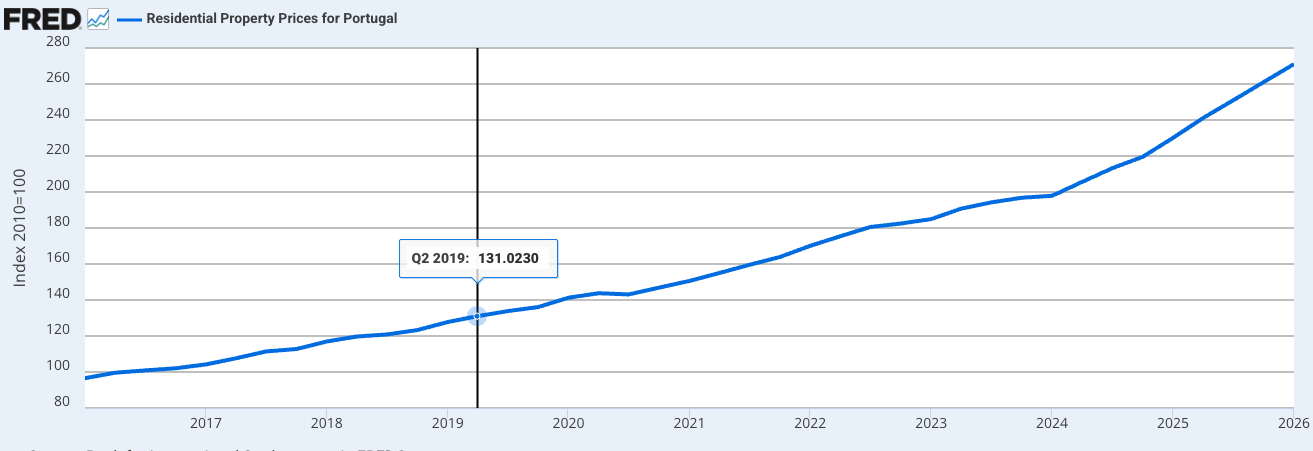
I believe that even though real estate can be a good way to explore investment opportunities, most people are much less aware of the real risks that exist, which are evermore real as less people investigate them.
This essay is an attempt to organize my views on real estate. I’ll try to access what makes a compelling opportunity, what are the risks, and what psychological reasons may affect investor’s view of the asset class. I also want to explain why, despite my long-standing skepticism, I eventually invested in a German REIT.
Why real estate feels safer than it is
Housing is a necessity. Everyone needs a place to live, and companies need a place to do business. The dynamics between owning and renting varies from culture to culture, as does the household formation, cohabitation and the use of commercial space. But the demand for physical space is real.
Housing is the biggest expense in the lifetime of most people. Naturally they will tend to believe their decision is financially sound. They will tend to rationalize the price paid, to be able to live comfortably with their decision.
Real estate is also more tangible than financial assets, which contributes to people feeling safer with them. Since there is no continuous market, prices look mostly invisible until the owner tries to sell them.
Debt is also perceived differently. People comfortably borrow several times their annual income. As long as they continue to pay their mortgage every month, they see no risk because prices tend to go up over time.
The tailwinds of the industry
This combination of factors make housing a much less volatile assets, which contributes to the reinforcement of the idea that it is safe.
These factors alone do not mean that housing is a bad investment, but it makes an argument of inflated prices that persists. Most people also have a reasonable intuition to house prices, making the market much less prone to substantially undervalued properties that make good investments. There are simple to many people looking at the market, making the market a very efficient one.
Real estate has been a very good business to be in in the last decade for most of the western world, and much more accentuated in Portugal, where I live. There have been two big trends that contributed to this, and then other small trends that also contributed.
The lack of construction
Construction is a high capital-intensive industry. It’s also a business with long term business cycle, sensible to interest rates. It has a lot of bad characteristics which, in my opinion, makes it a very bad business. However, that is one the reasons why we are in a good position for the industry nowadays.
Since the financial crisis in 2008 in the US and around 2012 in Europe, the levels of construction have fallen materially.
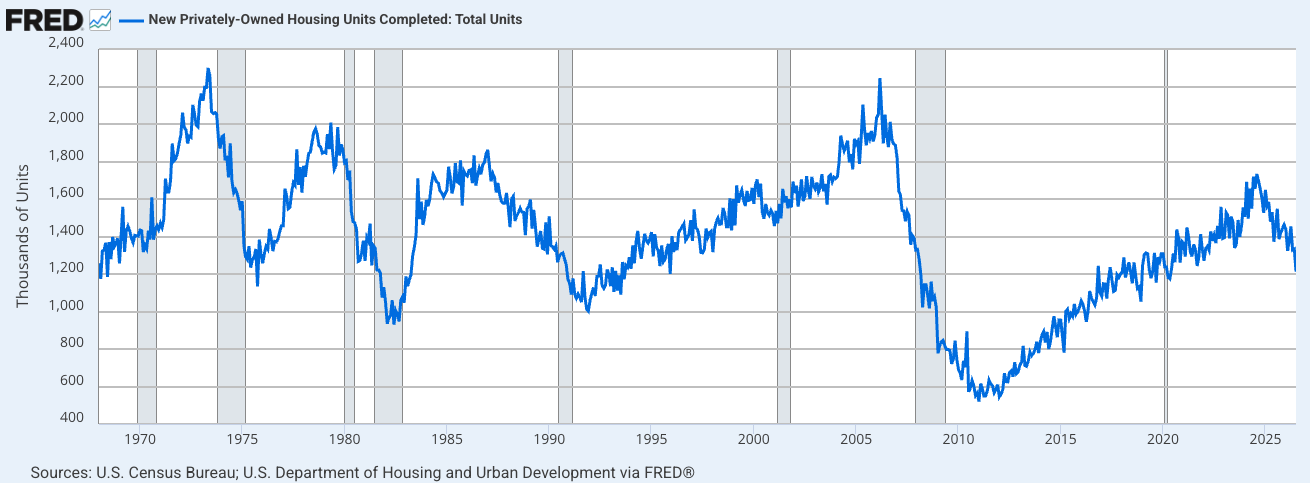
In the US, completed housing units have been below long-term average trends since the financial crisis in 2008. This resulted in a shortage of housing, and with population currently growing at 1.8 million annually, we are still building fewer homes than what it’s needed despite the aggregate shortage that the last years have created.
The same trend is happening in Germany and Portugal. Of course, this is something that needs to be looked at country by country and city by city, but the overall trend is that we have been building less homes than what is needed for the last decade. There is a very strong inverse correlation between house prices and construction levels of a country
A lot of companies simply went out of business, and operators became reluctant to build.
Part of the lack of construction persists because the fears are still present, and being the construction a long cycle business, people need to be confident about the future to make commitments. This has been changing in the last years, and sentiment has been improving. There seems to be an increase in activity which will bring more supply to the market.
There’s also a bureaucracy issue, where permits and audits are much more restricting nowadays. Building simple is much more regulated and it increases the costs and duration of the full cycle of the business, accentuating even more the problem.
One challenge in real estate is the long delay between incentives and outcomes. Higher prices may encourage developers to build today, but those additional homes will not reach the market for several years.
Low interest rates
Until Covid, interest rates were near zero or even negative. That made real assets a very good place to park your money.
However, since covid, interest rates have been steadily rising. If we look at the 10y bond yield for Germany, it went from negative to 3.2% today. It’s 4.7% for the US.
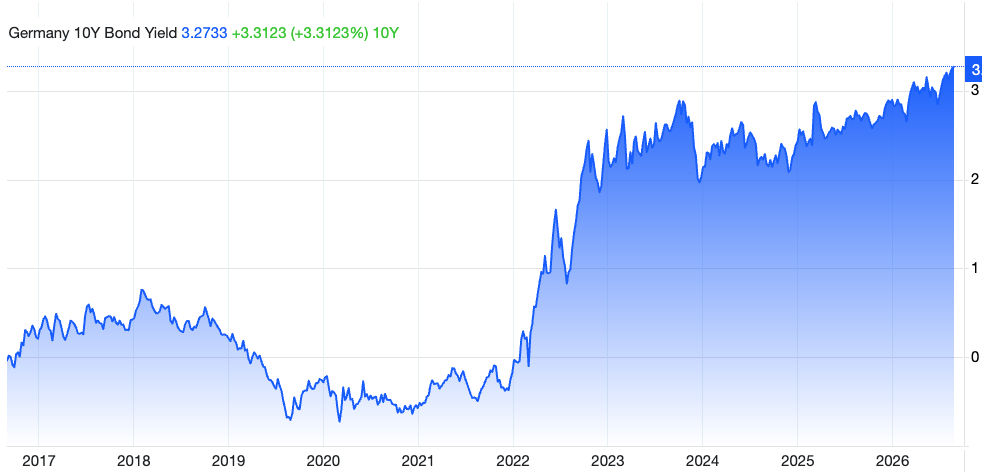
Money has become more expensive.
We have geopolitical conflicts in Ukraine-Russia and Iran. Commodities and Inflation are persistently higher than the 2%. This environment makes it much harder for simple asset appreciation. Current cash flows become much more important.
This environment has completely changed the appeal of real estate for me. For years, falling interest rates supported property values and made relatively low rental yields acceptable. That tailwind has now become a headwind. If a residential property offers a cap rate of 4% or 5%, while a government bond yields around 3.2%, the additional return is not particularly compelling once I account for maintenance, vacancies, taxes and the illiquidity of owning a physical asset. Rising wages and a shortage of homes have kept prices resilient, but resilience does not necessarily mean that today’s prices offer attractive returns.
Of course, this comparison only tells us so much. Interest rates are volatile, while a house may be held for decades. Today’s rates influence the price I am willing to pay, but the return will ultimately depend on how rates, rents and property values evolve over the years that follow. It’s not only today’s rates that matter, but the interest rates over a life cycle of the asset.
How I finally invested in real estate
For years, my concerns kept me away from the sector. Ironically, I entered it after the environment became visibly worse.
After Covid, inflation has been persistently higher, and interest rates risen sharply. The real estate market however, showed to be more resilient than I thought. However, most public listed real estate companies fall. I believe it created some disconnection in the market.
House prices have been persistently strong, but REITs have been priced aggressively.
I first invested in Grand City Properties, a German listed residential landlord, that focuses entirely in the residential space. Grand city properties stock had a discount to their NAV of 60%. Their financial situation looks stable.
After 6 months, Aroundtown, the main shareholder of the company with 62.5% and a more diversified real estate company, made a voluntary share-exchange offer for the rest of GCP shares and increase their position to 84%. Although I did not like the offer, and I would much rather own a pure residential company, i eventually ended up tender my shares. Management from GCP tendered their shares, and with Aroundtown reaching 84% the fate of both companies makes it riskier to own GCP.
Aroundtown has a mix of different types of real estate, with residential being around 33% of the business, office 34%, hotels 20% and rest in logistics development rights.
What is implied in the valuation
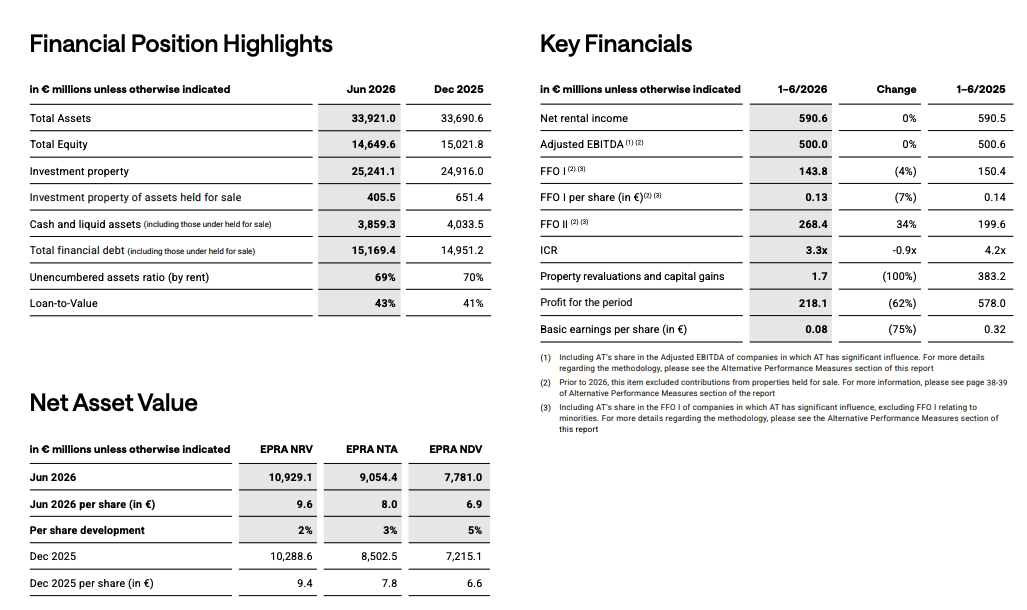
Aroundtown current price is around 2€ a share, which is a 75% discount to their NAV (using the net tangible asset as a measure). The company only have an 11-year tenure in the market but comparing the NAV with the current share price since the IPO, shows clearly a disconnect.
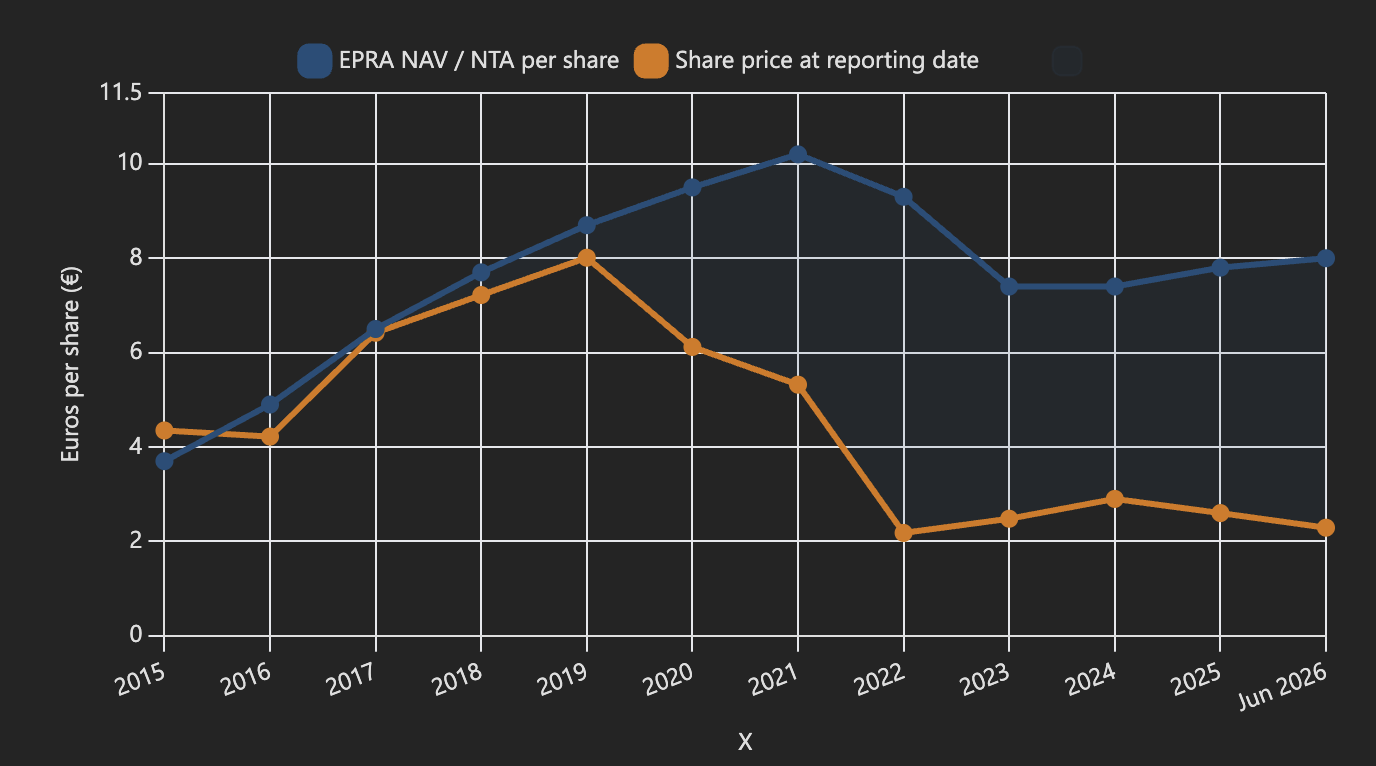
Since Covid, market is implying that NAV will fall substantially, which has not materialized.
However, one conclusion we can take is the discount can persist for a very long time. If your thesis relies in the discount to close, you better be a very patient person.
Their LTV is around 43% which excludes the perpetual notes (3.9 billion euros)
If we assume assets of €100 and debt of €43, the implied equity is valued at €57. A 75% discount to NAV means equity is valued at only €14.25. The market value of the assets is therefore €57.25, implying a decline of approximately 43%. If we consider the perpetuals, it still needs to fall by a little more than 30%.
However, the hotels and homes value has been very strong despite the rising interest rates.
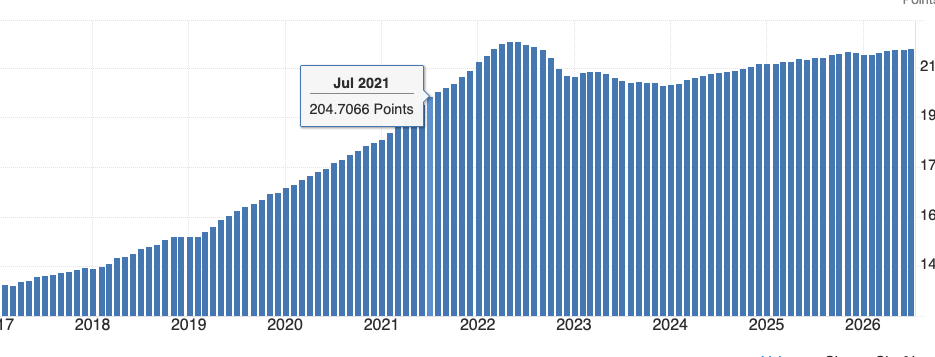
Currently, it’s almost at all-time highs. The largest pressure has come from offices. Management is converting some into service-apartments and selling others. I believe residential will become the biggest asset in the next year.
I do not believe we will see NAV falling considerable with the current environment. There is a real house short supply, and commercial is already reflected the new interest rate environment.
The bigger issue is the refinancing. Aroundtown has successfully been able to refinance their debt, but if interest rates persist, their cost of debt will raise in the next years from 2.4% to a higher value.
A real-estate investment that is partly a macro bet
I estimate an increase to 3.5% that will have an impact of 130M euros in their income, when the rest of their debt gets refinanced at higher rates. That would bring their FFO I yield from 12% currently to 7.5%. However, the true impact depends on how quickly the existing debt rolls over, future disposals, and how opportunistic they can be with their go to market strategy.
But I also believe they will be able to keep rising rents that will offset part of that effect. German rents are very regulated, making the increases lower than they should, but more stable over the long term. If they keep increasing it for 2 to 3% annually, they can counter most of the cost in interest expense.
Since I do not want to be dependent on closing the discount to NAV, this is more important for my overall expected returns.
They pretty much went opportunistically to the market this year already.
Over the next couple of years, my base case is that NAV and FFO may decrease slightly. At roughly 2€ per share, an investor buying shares today pay approximately around ten times normalized FFO under my assumptions. A double-digit annual return is likely even if interests rate remains at this level.
All businesses are affected by the economic cycle. However, I try to be invested in business where no matter what the environment, they can deliver good results.
I must be honest here. real estate is much more dependent on the overall environment, and it makes Aroundtown partly a macroeconomic bet.
My outcome depends more heavily than I would normally prefer on interest rates, inflation and credit-market conditions. If interest rates rise to 4 or 5%, the investment will not bring good returns. FFO would further drop with rising interest expenses. Property values would decline and the company will have to deleverage. Under those assumptions, returns would be very low, if they existed at all.
If credit markets close, a significant risk to the principal of the company exists.
The bear case is more complicated than property prices merely falling. Higher rates would reduce asset values, increase refinancing expenses and weaken the cash flow.
If that happens, the shares will keep trading at depressed values. A lot of that is already embedded in the stock price, so I currently see this with substantially more upside than downside.
Nevertheless, I do not see the same speculative dynamics in Germany or the Netherlands that I witnessed in Portugal before the financial crisis, or that I see in some parts of Portugal today. Rental regulation and constrained supply create their own complications, but they may also support continued rent growth where rents remain below market levels.
For these reasons, I would never make it a sizable position.
I am not certain that Aroundtown will remain in my portfolio permanently, which sometimes makes me question whether I should own it at all. For now, I believe the expected return compensates me for the risks. The extent to which interest rates and credit markets can influence my returns still leaves me uncomfortable. While the current price gives some cushion against further deterioration in conditions, I am aware of how far more dependent on external factors than other businesses that I own. But again, even though I finally made one investment in real estate, my fears and discomfort do not seem to have disappeared completely. I wonder how much is rational and how much is my past still hanging around.
Note: I eventually sold my position. In the end, the concerns discussed in this article outweighed the potential upside for me. I no longer want to depend on favorable macroeconomic conditions for an investment to work. I’d rather keep cash available and deploy it into businesses that I believe can succeed regardless of the macro environment.
 Diogo Gonçalves
Leave a comment