Adyen results for the first semester are out. The company continues to execute exceptional well, growing much faster than the industry, and continues to add new functionalities for their customers, either by the new acquisitions or built internally.
Combining a trusted management, with a lot of experience in the industry, a pristine balance sheet and the growth while increasing the value added of their products makes it a compelling investment for long-term shareholders.
The results were broadly consistent with what Adyen has delivered over the past several years. They keep executing very well, continuing to deliver 20% top line revenue, while maintaining by far the best margins in the industry.
I continue to expect Adyen to deliver revenue growth in line with previous years, and improved margins from 2027 forward, as the initial acquisition costs and accelerated investments are absorbed. The company has a lot of operating leverage as the majority of their costs are fixed.
The growth gap is widening
If we look at the following chart we can easily point out where the future growth of the industry is headed.
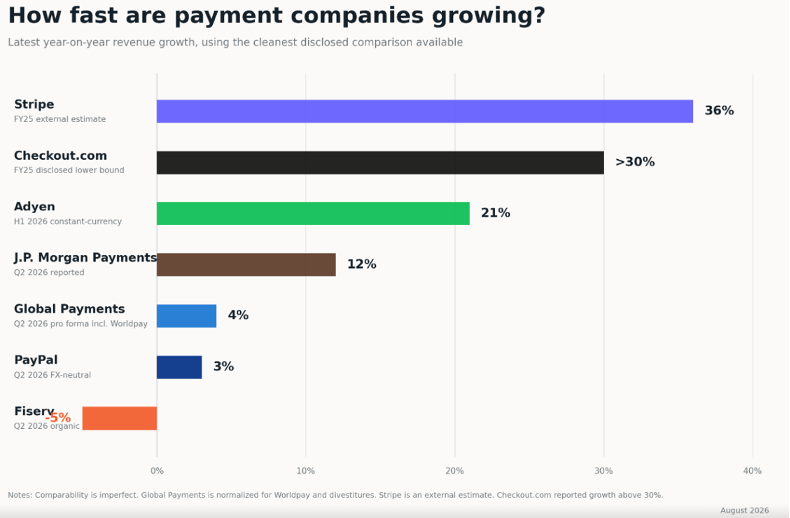
The growing gap is widening between Checkout.com, Stripe and Adyen and the legacy players. Those ones remain mostly stagnant with the exception of J.P Morgan. JP Morgan Payments reported 12% growth, but this figure benefits from deposit and fees growth, so it’s not an equivalent to the other companies.
Checkout.com and Stripe remain private companies, so our visibility is limited. Stripe does not disclose complete revenue figures, while Checkout has disclosed but did not provide detailed financial statements.
Moving beyond payments
Adyen keeps adding more functionality to their services, and this semester was no different. From the two acquisitions, Talon.one brings to the company loyalty and promotion capabilities, and from Orb the usage-based billings that has become so prevalent in software since the advent of AI in the last years.
They also introduced Adyen Agentic and Intelligent Money Movement, built in-house, in response to customer conversation about their needs.
Adyen is trying to control more of the merchant’s relationship before and after the transaction. If executed well, this will make them stickier and increase the value-added services provided to their clients.
The integration of the two companies started just two months ago, and I don’t think we will know how they are going until at least until end of the year.
However, the strategy seems to make perfect sense. Control more of the flow pre-transaction and post-transaction and become a financial infrastructure company more than just a payments company.
The reported joint bid by Stripe and Advent Internation for PayPal gives me some pause. Even though I think the price can be compelling, and there is some complementary business that could help stripe, it is a huge acquisition that if it happens will put a drag on them for years.
Integrations are much harder to do than most people think.
I like that management in Adyen acknowledges this, and Peter even talk about that in the conference call. Especially acquisition for synergies and cut costs. Not only they are hard to do, but they also affect the morale of the employes.
Relevant customer wins
Two new wins are interesting this quarter: OpenAI, which the new acquisition of Orb probably contributed. Peter announced they only gained them as a payment infrastructure, and not as their billing meter company. He tried to avoid speaking much about it, but you understood that the company has at least in mind that they will fight to expand there with them.
This is a huge win in two different aspects: first OpenAI is already a huge company. And second, this is not their typical merchant, showing that they will are expanding their services into more different business, and winning digital costumers against Stripe
There was also the expansion of the partnership they had with Toast in the US. Toast is a huge business with more than $215 billion gross payment volume. Although they compete in niches, it validates the core infrastructure that Adyen build.
Performance by Pillar and Region
Platforms continue to be the fastest growing segment. This is more material because its growth directly where Stripe has historically been strong.
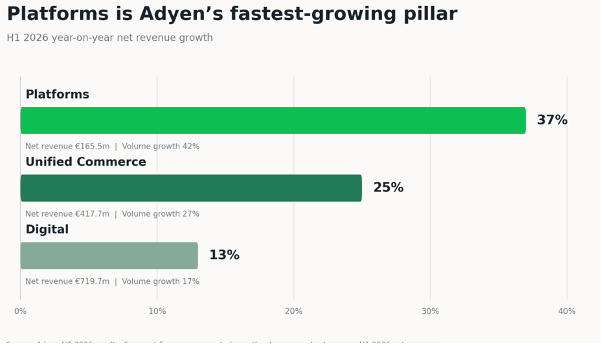
I’ll keep looking at overall growth for the health of the business, expecting them to growth in digital and unified commerce, but with a special focus in growing market share in platforms.
A pristine balance sheet
Adyen has always had a strong balance sheet. They have a substantial net cash position (around €4 billion euros), even though not all of that is available in the short term to be utilized, this insulates them against any backdrop in the industry. Most payment companies carry a significant amount of debt. This gives them flexibility and capacity to invest in the business.
That was reflected in the pull forward for more data center infrastructure in the H2 of 2026.
Cash available at all times gives you a frame of mind that allows you to be rational and make good decisions.
It also allows them to benefit from higher interest rates. Adyen gets €300 million euros in financial income, where again, most competitors have very high payments to serve their debt.
What could go wrong?
While the company is very much on the right track, there are several ways to look for to keep evaluation the thesis.
First, we should carefully track how the integrations are doing. This is the first time they acquire a company, and it can be a drag on their performance.
Second, they are entering into new adjacent line of business. While it increases the moat has the financial infrastructure end to end player, it also opens new competition layers that should be closely followed.
The exited of their CFO can also be concerning. Usually it’s not a good sign, but in this case, accepting an opportunity outside fintech seems to be the real reason.
Conclusion
I see a company with a very trusted management, that are very experienced in the industry.
Before founding Adyen 20 years ago, Peter created another payments company that was later sold to WorldPay. He has been in business for most of his life. Management is also very focused in customer needs and in business.
They maintain a pristine balance sheet, keep adding new features to provide value, own their own data infrastructure, banking licenses and keep getting new costumers.
Most of their revenue growth still comes from existing customers, as merchants expand their relationship with the company. A concept they call share of wallet. It makes the growth more predictable they growth from acquiring new customers.
They have the lower cost of the industry for large merchants.
The valuation does not seem too high for me, currently trading at 22 times 2027 earnings, for a company growing at 20% and still expanding margins.
My cost basis is at 829€ a share, and I’m almost tempted to buy more if the price falls back in the next couple of months. Either way, I’m not selling a single share in the near future.
I have a lot of confidence and conviction in the future of Adyen.
 Diogo Gonçalves
Leave a comment