Atlassian and Trade Desk
Two of my companies announce earnings last week: Atlassian and Trade Desk.
Atlassian had some outstanding results, while Trade desk’s results were disastrous.
The Trade Desk: A Thesis Under Pressure
Trade desk had an outstanding track record since its IPO. I truly admire Jeff Green, and the company he is building. The whole thesis for the company focuses on two points: Advertising is a buyer’s market. There is infinitely more supply than demand. As Erif Seufert from MobileDevMemo points: Everything is an ad network. As long as you have an audience, being it podcasts, movies, blogs, physical environments, you can publicize. Therefore, demand has infinite venues, and we need an aggregator that can held the most possible places, and with the right tools to measure it, improve the quality of adverting.
Advertising has always been very hard to measure: The famous quote: “Half the money I spend on advertising is wasted; the trouble is I don’t know which half”, attributed to John Wanamaker in the 19th century, is still true today. With the arrival of internet, and specially with what Alphabet and Meta did in advertising, making advertising more targeted and with a higher rate of success has been a secular shift in the last 30 years.
However, much is still badly spent. An aggregator that can effectively distribute advertising in the best way possible will always bring a good value proposition.
The second part of the thesis is that the giants in the industry: Meta and Google, build the most reliable engines to measure it, but since they have huge business that are still growing so fast, they are not prioritizing advertising in the best possible way. Instead, more of the ads are being send to their closed wallets. This can be seen very clearly in Alphabet: Google network revenues have remained flat for the last years, since Alphabet is clearly not making a priority in the open internet anymore, and it’s shifting more of the advertising revenues to their own products.
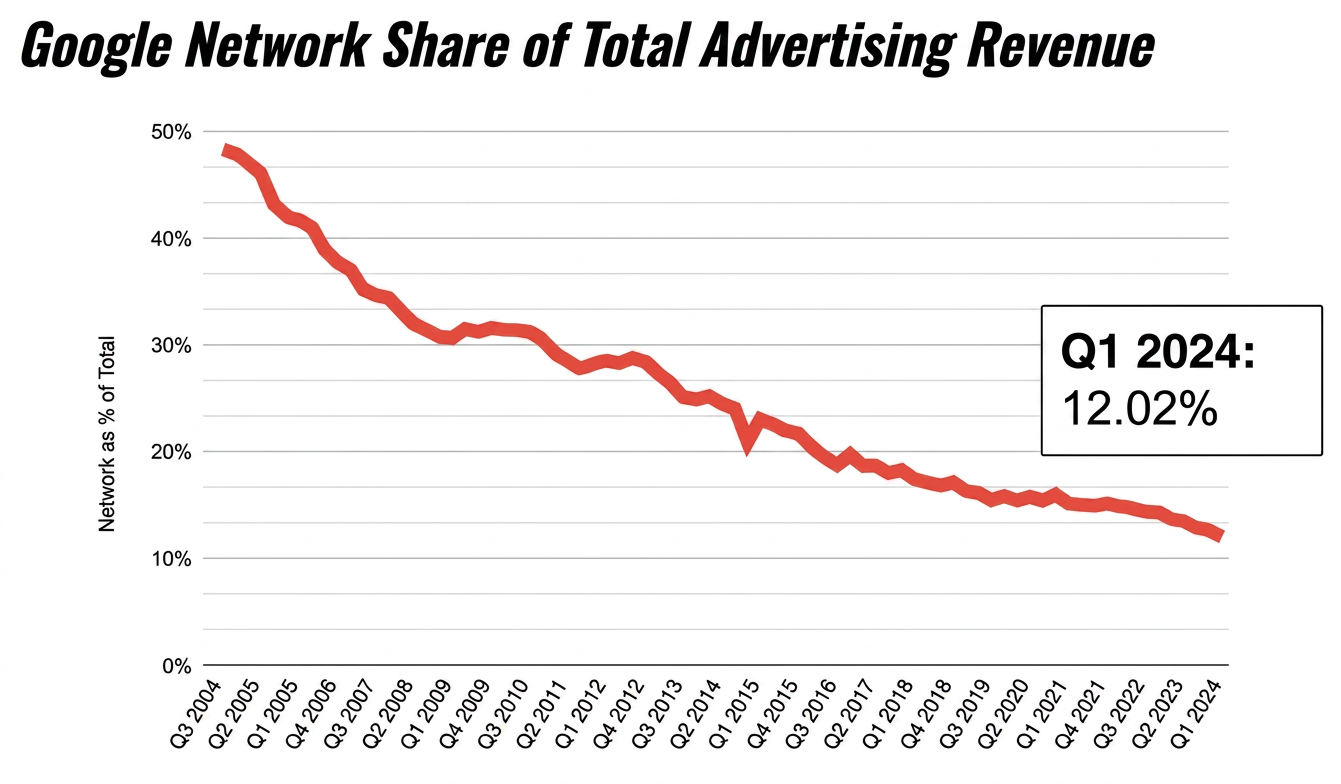
In theory, this should make trade desk more value for advertisers, as they remain an independent platform, that do now prioritize one product. Instead, their whole focus is on bringing the best possible solution for the clients: it does not matter for them if the advertising is sent to Disney, to Spotify, or any other venue.
However, this tendency has not help Trade Desk at all. Since the internal machine of google and meta are so good, more and more advertising have continuously flowed to them.
To complicate things even further. Amazon has entered the space with its own DSP. Jeff keeps pointing that Amazon has the same problem: they have a big advertising business and are not truly independent, which in the long term will not be in the best interest of advertisers.
Jeff Green continues to argue that advertisers will ultimately prefer an independent platform. I think that argument is intellectually compelling. The problem is that the market has not behaved that way. Advertisers continue to direct increasing amounts of spending toward Google, Meta, and increasingly Amazon.
Insights from people working at Amazon DSP show they haven’t prioritized their internal ad business over others. And Amazon has showed to be a fierce opponent here, as it has shown in their other business.
More competition for Trade desk and more percentage of ad revenues flowing to the closed wallets have making trade desk business harder, and that is reflected in the numbers, with then guiding for -12% revenues for the next quarter.
Trade desk is still a profitable business, and I do believe they have a place in the industry, but the thesis has been very much affected.
Therefore, I’m selling my position with a 70% loss which is a huge loss. The good thing is that, currently, trade desk is only 0.5% of my portfolio and was around 1.5% only at cost basis.
I hope Jeff Green can find a way to turnaround the current situation, but I think they will have a hard couple of years and it’s not sure they can go back to growth in the near future.
They have been called macro as a big problem, but all the big advertising business are growing just fine. Since advertising is also a cyclical industry, I think further downside can still happen if we enter a recession. Moreover, I do not know what they can do to turnaround the company.
While I still admire Jeff Green and believe Trade Desk will remain relevant, I no longer believe the company has the competitive position required to generate the returns I originally expected. At 0.5% of my portfolio, the position isn’t going to change my life one way or another, but it’s time to departure and deploy that capital elsewhere
Atlassian: Stronger Than Ever
Atlassian, on the other end, has accelerated and had stellar results. Stock was very depressed, as the AI threat has affected all SaaS valuations. Not all software business is going to survive this, but they have clearly showed they are a beneficiary of this trend.
Atlassian is one of the best software companies ever built. The team did not stay still, and the amount of innovation they have done in the last couple of years is outstanding. Even without looking at the normal, this is a team I want to bet my money on.
As a software developer, I probably spend more time inside Atlassian products than inside any other software ecosystem outside Microsoft. Jira is where work gets planned. Confluence is where knowledge is stored. These are not tools that teams casually replace. Migrating years of tickets, workflows, documentation, automations and integrations is a painful exercise.
Jira service management has grown into a number 2 in the service management business, still growing faster than ServiceNow.
The way they implemented Rovo and other AI features in their software, I haven’t seen any other software company implementing this so well and so fast.
I truly feel they have been adding a lot of value to their customers. Even after this 35% return after earnings, the company is valued at 5x revenues and 15 non-GAAP earnings for 2027 financial calendar year.
And the company has been growing for 20%+.
Some of the excess growth this year has been due to the end of the data center business, which pulled forward the revenues from the next year. In 2027 they will grow only 13-15%, but I expect the business to go back to their long-term trajectory of 20% after.
The founder also announced he is buying $250 million dollars of shares in the open market, showing his confidence in the business.
The company main issue for value investors, as most of software business, has been the compensation for employees depressing GAAP earnings. The company is also addressing this now. It reported their first GAAP earnings in the quarter, and they will have their first year with positive earnings, which will follow salesforce example last year.
They can easily go for +20% profit margins very fast.
The next couple of years will bring a lot of positives for the company. I am more confident than ever on the company.
Maintaining the multiple, I believe they can grow earnings at +15% for the next decade. Mike Cannon-Brookes is a visionary, completely focus on adapting the company into this era, and he owns a very substantial part of the business. The market spent the last two years worrying that AI would make Atlassian obsolete. After this quarter, I believe the opposite is becoming increasingly likely. Atlassian is one of the software companies best positioned to benefit from AI, and I expect it to emerge from this transition stronger than it entered it.
 Diogo Gonçalves
Leave a comment