Alphabet released its second-quarter earnings a few days ago, and there isn’t much not to like.
Its results strengthen the case that its extraordinary capital spending is not merely defensive AI expenditure. I am still not fully convinced, but the company is investing behind demonstrated Cloud demand, improving margins and a consumer AI product approaching one billion monthly users, while Search continues to finance the transition.
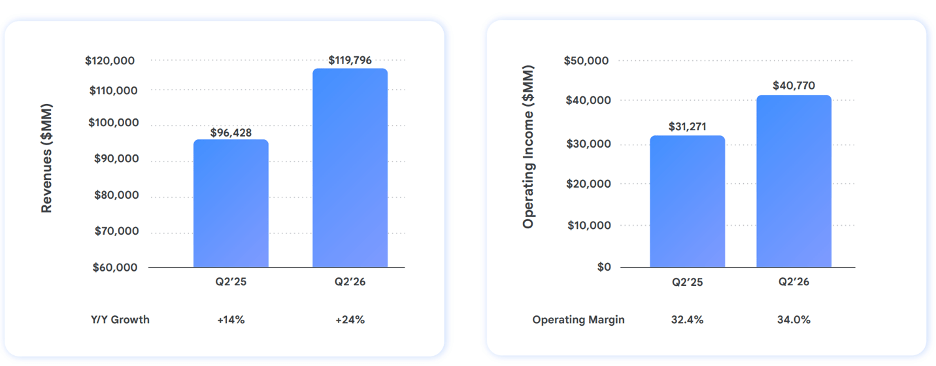
Revenue accelerated to $119.8 billion, an increase of 24% YoY, while operating margins expanded to 34%. The company has now been accelerating its revenue for six consecutive quarters. The most important result was Google Cloud. Strong growth was expected, but I did not expect 82% growth at this scale.
Cloud is the central theme
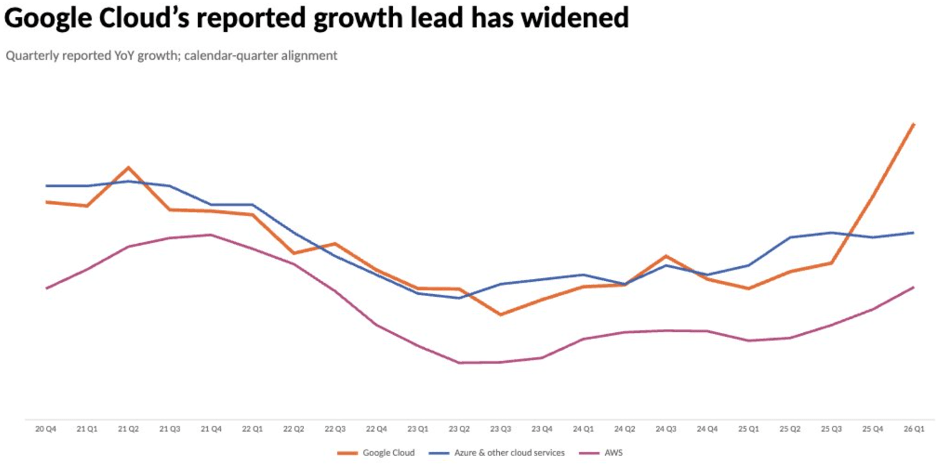
A business that is now reaching an annualized revenue run rate of $100 billion dollars and is still growing at 82%. All hyperscalers entered a new acceleration phase of their cloud business, but i believe google laid the foundation to execute on this better than their competitors, and that can be seen in the last couple of quarters, where their growth increased a lot more than Microsoft and Amazon.
Alphabet is running ahead at full speed
These numbers changed how I look at Alphabet’s investment program. If Cloud were growing quickly but margins were falling, I would be much more worried. Instead, margins expanded, despite the absorption of Wiz business, and backlog increased.
That does not prove the eventual return on the infrastructure, but it is much better evidence than management simply telling investors that demand is strong.
I do not treat the more than $500 billions of backlog as guaranteed high-margin revenue. Some commitments will be recognized over several years, some may depend on actual customer consumption, and I do not know what margins they will eventually carry.
Still, it is difficult to reconcile that level of contracted demand with the argument that Google is building entirely ahead of the market.
Google is not only supplying their customers, but also are building a massive distribution channel with Gemini. Even though all hyperscalers are supply-constrained right now, that is even more true for them.
Since they do not want to lose business, for the second half of this year, Google has also reached to third parties to provide them with supply. Buying third-party capacity will pressure margins, but I think refusing customer demand would be worse. Google would save some margin today while giving customers a reason to build their workloads with AWS or Azure instead.
Gemini
Gemini app is quickly closing the gap against ChatGPT. If this trend continues, Google may have surpassed it by the end of the year.
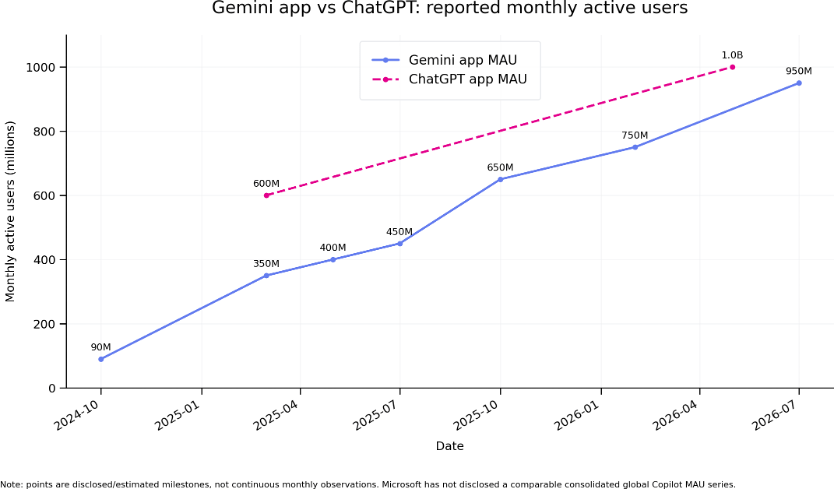
I see no reason why that won’t be the case. Even though we do not know long term what the impact on search will be, in a matter of 3 years Google has created a new business with almost 1B monthly users. That is unprecedented.
I wouldn’t bet against its ability to execute.
Search continues to surprise
Search is still growing at 17% which for me, is surprising. So far, Google appears to have integrated AI Overviews and AI Mode without damaging Search revenue. Management also argues that AI is improving relevance and allowing Google to monetize more complex queries.
I am not yet convinced that this can continue indefinitely. Search usage could grow while the economic value of each query declines
I do believe there is still considerably risk. I would become concerned if Search revenue began materially lagging query growth or if advertisers achieved weaker returns from AI-driven interfaces.
YouTube and Netflix
Youtube also keeps growing at double digits, helped this quarter by the FIFA World cup. For the first time it was possible to see the games live in Youtube.
I keep returning to the comparison between YouTube and Netflix because it shows how underappreciated YouTube’s scale has become.
Both businesses are around the same size and growing more less the same. Youtube did $11 billion in revenues, but there is a seasonality effect, with Q4 being stronger. This also does not consider Youtube subscriptions, only ads.
Netflix did $12.5 billions in revenue.
However, Netflix is much more capital intensive and spends huge amounts of money in IP, while Youtube does not bear the same cost. I suspect YouTube has structurally better economics, although Alphabet’s disclosures do not allow me to calculate its standalone margin precisely. They do distribute approximately 50% of their revenue to the content producers, so it’s not that it’s free content for them.
The capex controversy
One aspect that is making investors nervous for quite a while is the capex spending. Alphabet raised again their spending this year, this time from $180-$190 billion to around $195-$205 billion.
They have also publicly said that in 2027 capex will be meaningful higher.
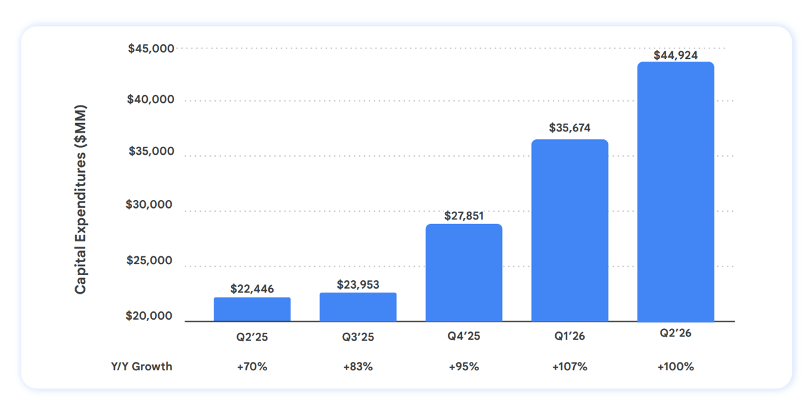
They have been growing capex at close to 100% annually, and the pace does not appear to slow anytime soon I share the market’s concern: nobody knows what the true ROI on these investments will be. Markets hate uncertainty, particularly when hundreds of billions of dollars are being committed.
This is especially true because it’s first quarter of negative free cash flow in history.
However, from an owner’s perspective, this is an incredible situation to be in.
First, Google can use this computing capacity both internally and through Google Cloud. Even if the current AI boom turns out to be more hype than substance, the capacity won’t become entirely redundant. If you believe that Youtube, Search, Google workspace and Google’s other applications continue to growth, the company will just be able to absorb much of the new capacity.
Second, Google have been supply-constrained for years now and still are. It has 500B+ of contracted commitments in its backlog. Its Cloud business has reached 35% operating margins. When you have a business with those margins, and customers are dying for you to provide them additional capacity, choosing not to invest would be irrational.
I believe this quarter reduces the uncertainty surrounding the return on this capex. Google is investing behind demonstrated demand, attractive margins and infrastructure that also strengthens its existing products.
Depreciation and the economic life of AI infrastructure
There has been a lot of discussions around depreciation, and the growing gap between the cash flows and earnings. Major shifts occurred predominantly between 2020 and 2023, when Amazon, Microsoft and Google extended the useful life assumptions of it’s servers from 3-4 years up to 5-6 years, having a direct impact in their earnings. Some bears used that to create a bear case, where earnings are not representing the reality of the underlining profits.
It’s a fair concern, but I don’t believe it is entirely valid. There is an argument to be made, that even with the extension, it is too conservative. For example, Nvidia released the A100 chip in 2020. However, those chips still have around 100% utilization 6 years later.
The secondary market for A100s remains active, and available evidence suggests older accelerators can retain economic value for five to seven years or longer. Used A100s can be particularly competitive for inference and fine-tuning workloads where the newest hardware does not justify its higher price.
Old GPU remain useful, because not all workloads need state of the art hardware. When new chips arrive, like Blackwell or Rubin, Google can move older hardware to:
- YouTube recommendations
- Smaller Gemini models
- Workspace features
- Internal search workloads
It is also why Alphabet may have a better risk profile than a narrowly focused neocloud. That flexibility also allows Alphabet to move older hardware into lower-value internal workloads as newer chips take over frontier applications.
A much better way to evaluate this are alternative measurements like cost per token, or token per watt. Here, the lower Gemini models cost can retrieve more information about the reality of its assets, that we cannot fully grasp around the depreciation. It is also true that some can be attributed to software optimization.
The accounting question should therefore not be reduced to whether a server remains operational after five or six years. The better question is whether the server continues to produce sufficient economic value throughout that period to justify its original cost and depreciation schedule.
My current view is that the risk of rapid and complete technological obsolescence is overstated for Alphabet.
This makes depreciation an important variable to monitor, but not necessarily evidence that Alphabet’s current earnings are materially overstated.
Alphabet has room to make mistakes
They have also been building a fortress of a balance sheet. Between the equity and debt raises, and the 40B ATM available in the future, there is no one who is better position to expand this business.
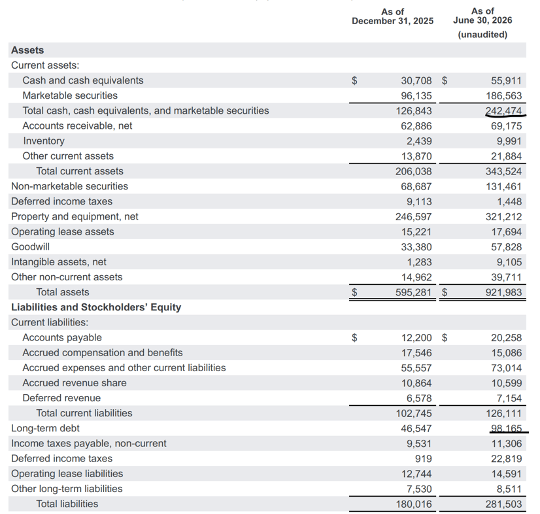
Google have $242.5B in cash and marketable securities available with 98B in debt. Consensus estimates also suggests Alphabet could generate around $200 billion in operating cash flow for 2027.
For comparison,
| Company | Balance-sheet date | Cash & short-term investments | Total debt incl. leases | Net debt / (net cash) | Expected 2027 FCF |
| Oracle | May 2026 | $31.9B | $156.2B | $124.3B net debt | -$49.3B |
| Meta | Mar. 2026 | $81.2B | $86.8B | $5.6B net debt | -$4.4B |
| Alphabet | Jun. 2026 | ~$240B | ~$98B | ~$142B net cash | Around $0B |
| Amazon | Mar. 2026 | $143.1B | $209.9B | $66.8B net debt | $19.4B |
| Microsoft | Mar. 2026 | $78.2B | $125.4B | $47.2B net debt | $57.1B |
Oracle is clearly in trouble, their debt recently reached an 8% yield in the market, and they don’t have to further expand without raising equity.
Meta also does not have the necessary scale to compete with the hyperscalers. Much of their compute will be used internally. Even though they recently talked about selling compute to third parties, I believe they will eventually use their compute only internally.
For the hyperscalers, Alphabet has the better balance sheet and produces the largest cash flow among the three. If Google Cloud sustains a materially higher growth rate than Azure over the next couple of years, it could challenge Microsoft for second place by 2028 or 2029. Depending on Microsoft results this quarter, this can become my base case thesis.
Google is firing on all cylinders. The hardware business is amazing, operationally it’s been executing better than its peers when it comes to building infrastructure, its advertising business continues to surprisingly grow at double digits, they have the strongest balance sheet in the industry. At the same time, it remains one of the few companies able to compete in the frontier of AI.
Gemini may have fallen behind recently, but it’s an extremely dynamic and competitive environment right now. Google has all the cards to be able to compete at the frontier level, and they will keep doing so. Besides, Gemini App has almost 1B monthly users, and distribution is something that you won’t see a new model like Kimi reach, even if they stay on top in the benchmark. Benchmarks alone won’t translate to widespread adoption.
If anything, I’m even more bullish on Google, particularly over the next 2 years.
I still do not know what return Alphabet will earn on close to $200 billion of annual capex. I do not know whether Cloud margins above 35% will survive once the industry is no longer supply-constrained. And I do not know how much economic value Gemini’s enormous user base will ultimately produce.
What I do know is that the current investment is being made behind demonstrated demand rather than management forecasts alone. Alphabet can monetize the infrastructure internally and externally, Search continues to finance the transition, and the balance sheet provides room for mistakes.
I will monitor two variables most closely:
- Search: Weather revenue can continue its double-digit trajectory, or anything that shows search is become less value from an advertiser’s standpoint.
- Gemini: Weather it can continue improving without failing materially and stay close to the Pareto frontier, while increasing its distribution.
Alphabet has everything to be one of the principal economic winners from AI.
 Diogo Gonçalves
Leave a comment